
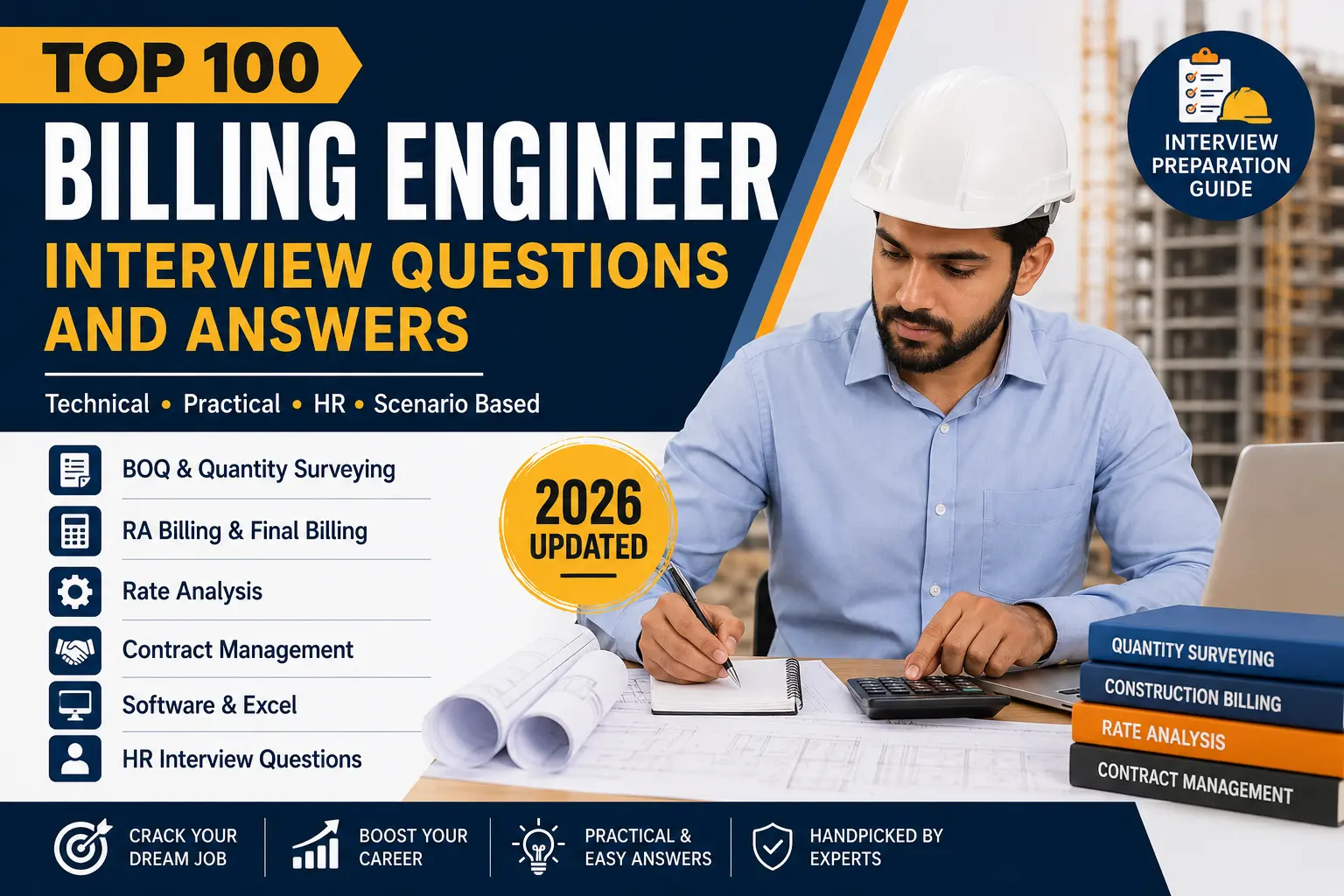
Prepare for your next construction job with the Top 100 Billing Engineer Interview Questions and Answers. Learn BOQ, RA Bills, Quantity Surveying, Billing, Contracts, Rate Analysis, Excel, and practical interview tips for freshers and experienced engineers.
Billing Engineer Interview Questions
If you are preparing for a Billing Engineer Interview, one of the smartest ways to increase your chances of selection is to practice Billing Engineer Interview Questions asked by leading construction companies. Recruiters today expect candidates to demonstrate practical knowledge of BOQ preparation, quantity surveying, RA billing, rate analysis, contract management, material reconciliation, and construction billing.
This comprehensive guide on Billing Engineer Interview Questions has been specially prepared for Civil Engineering students, fresh graduates, Site Engineers, Quantity Surveyors, Junior Billing Engineers, and experienced professionals who are planning to attend interviews in the construction industry.
Unlike generic interview guides, this article explains not only the answers but also the practical concepts behind each topic. Whether you are attending interviews for residential, commercial, infrastructure, industrial, or EPC projects, these Billing Engineer Interview Questions and Answers will help you understand the commercial side of civil engineering projects.
Quick Answer: A Billing Engineer is responsible for quantity measurement, BOQ verification, RA Bill preparation, client billing, subcontractor billing, rate analysis, material reconciliation, and project cost control. Employers assess these skills through practical and technical interview questions.
Table of Contents
- What is a Billing Engineer?
- Roles and Responsibilities of a Billing Engineer
- Skills Required for Billing Engineers
- Basic Billing Engineer Interview Questions
- BOQ Interview Questions
- Quantity Surveying Interview Questions
- RA Bill Interview Questions
- Contract Management Questions
- Practical Site Billing Questions
- Excel & Software Questions
- HR Interview Questions
- Salary Guide
- Expert Interview Tips
- FAQs
What is a Billing Engineer?
A Billing Engineer is a civil engineering professional responsible for measuring executed work, preparing contractor bills, verifying quantities, maintaining billing records, and coordinating with clients, consultants, and subcontractors for timely payment certification.
Billing Engineers play a vital role in ensuring that every payment made during a construction project is based on actual work completed and complies with the contract conditions.
From residential buildings to metro rail projects and highways, almost every construction project requires a Billing Engineer to manage the financial documentation of executed work.
Roles and Responsibilities of a Billing Engineer
Understanding the responsibilities of a Billing Engineer is essential because many Billing Engineer Interview Questions are based on daily site activities.
The major responsibilities include:
- Preparing Running Account (RA) Bills
- Preparing Final Bills
- Quantity Take-Off from Drawings
- BOQ Verification
- Client Billing
- Subcontractor Billing
- Measurement Sheet Preparation
- Rate Analysis
- Material Reconciliation
- Cost Monitoring
- Variation Statements
- Extra Item Analysis
- Joint Measurements
- Coordination with Consultants
- Maintaining Measurement Book (MB)
- Preparing Work Progress Reports
A skilled Billing Engineer not only prepares bills but also helps control project costs by ensuring accurate measurements and documentation.
Skills Required to Crack Billing Engineer Interviews
Employers expect Billing Engineers to possess both technical and commercial knowledge. During a Billing Engineer Interview, candidates should demonstrate proficiency in the following areas:
Technical Skills
- Quantity Surveying
- Construction Drawings
- BOQ Preparation
- Estimation & Costing
- Rate Analysis
- RCC & Finishing Work Measurements
- Material Reconciliation
- Contract Administration
- Client Billing
- Subcontractor Billing
Software Skills
- Microsoft Excel
- AutoCAD
- CostX
- PlanSwift
- Bluebeam
- SAP
- ERP Systems
- Primavera P6
- MS Project
Soft Skills
- Communication
- Accuracy
- Time Management
- Analytical Thinking
- Documentation
- Team Coordination
- Problem Solving
How to Draw a Building Plan Using AI (Step-by-Step Guide 2026)
Basic Billing Engineer Interview Questions and Answers
1. Who is a Billing Engineer?
Answer:
A Billing Engineer is responsible for measuring completed work, preparing Running Account Bills, checking BOQ quantities, preparing client and subcontractor bills, verifying measurements, maintaining billing records, and coordinating with consultants for payment certification.
2. What is the primary responsibility of a Billing Engineer?
The primary responsibility is to ensure that every bill accurately reflects the work executed at the construction site according to approved drawings, BOQ, and contract conditions.
3. What is BOQ?
Answer:
BOQ (Bill of Quantities) is a document that lists every work item, its unit, quantity, and rate. It forms the basis for tendering, billing, and project cost control.
A standard BOQ contains:
- Item Description
- Unit
- Quantity
- Rate
- Amount
- Technical Specification
4. Why is BOQ important?
BOQ helps:
- Estimate project cost
- Prepare tenders
- Measure executed work
- Verify contractor claims
- Control project expenditure
- Prepare Running Account Bills
Top BIM Software for Construction Companies in 2025: A Complete Guide
5. What is Quantity Take-Off?
Quantity Take-Off is the process of calculating quantities directly from approved construction drawings.
Examples include:
- Concrete Quantity
- Steel Quantity
- Brickwork Quantity
- Plaster Quantity
- Flooring Quantity
- Excavation Quantity
6. What is an RA Bill?
Answer:
A Running Account Bill (RA Bill) is a periodic bill submitted by the contractor for work completed during a specific billing cycle. It enables the contractor to receive progressive payments while the project is under construction.
7. Difference Between RA Bill and Final Bill
| RA Bill | Final Bill |
|---|---|
| Prepared during project execution | Prepared after project completion |
| Periodic payment | Final settlement |
| Multiple RA Bills | Only one Final Bill |
| Includes current work | Includes entire project |
8. What is a Measurement Book (MB)?
Measurement Book (MB) is an official record in which actual site measurements are documented before preparing contractor bills.
The MB serves as supporting evidence for payment certification and auditing.
9. What is Joint Measurement?
Joint Measurement is carried out in the presence of:
- Client
- Consultant
- Contractor
It ensures transparency and minimizes billing disputes.
10. What is an Abstract Sheet?
An Abstract Sheet summarizes measured quantities and calculates the payable amount before preparing the RA Bill.
Quantity Surveying Interview Questions
11. What is Quantity Surveying?
Quantity Surveying is the process of estimating quantities, preparing BOQs, monitoring project costs, preparing bills, verifying contractor claims, and controlling construction expenditure throughout the project lifecycle.
12. Which IS Code is used for measurement?
The standard used for civil engineering measurement in India is IS 1200 – Methods of Measurement of Building and Civil Engineering Works.
In India, construction quantities are generally measured according to IS 1200 – Methods of Measurement of Building and Civil Engineering Works published by the Bureau of Indian Standards (BIS). Billing Engineers should be familiar with these standards because they are widely followed for quantity surveying, billing, and contract measurements.
Knowledge of IS 1200 is important because interviewers frequently ask practical measurement-related questions.
13. How is Concrete measured?
Concrete is measured in Cubic Metres (m³).
Formula:
Quantity = Length × Width × Depth
Top BIM Software for Construction Companies in 2025: A Complete Guide
14. How is Brickwork measured?
Brickwork is generally measured in Cubic Metres (m³) as per IS 1200.
Deductions for openings are made according to the applicable measurement rules.
15. How is Plaster measured?
Plaster is measured in Square Metres (m²).
The thickness of plaster (12 mm, 15 mm, 20 mm, etc.) should be clearly specified in the BOQ.
AI Prompts for BOQ & Estimation – Save Hours in Quantity Calculations [Civil Engineers’ Guide]
Expert Tip
During a Billing Engineer Interview, don’t simply define technical terms. Explain how you have applied them in a real project or academic exercise. Interviewers value practical understanding far more than memorized definitions.
Why These Billing Engineer Interview Questions Matter
Construction companies are increasingly looking for professionals who understand both engineering execution and commercial management. A Billing Engineer who can accurately measure work, prepare bills, verify contracts, and coordinate with stakeholders directly contributes to a project’s financial health.
Preparing these Billing Engineer Interview Questions will not only improve your interview performance but also strengthen your understanding of Quantity Surveying, Cost Control, BOQ preparation, Rate Analysis, and Construction Billing, making you a more competent civil engineering professional.
BOQ Interview Questions for Billing Engineers
A strong understanding of the Bill of Quantities (BOQ) is essential for every Billing Engineer. Most Billing Engineer Interview Questions begin with BOQ because it forms the foundation of construction billing, estimation, quantity surveying, and cost control. Whether you are attending a Billing Engineer Interview as a fresher or an experienced professional, you should be able to explain BOQ concepts with practical examples.
Generative Ai in Construction 2025 – Smarter Project Planning & Innovative Design [Expert Guide]
16. What is a BOQ?
Answer:
A Bill of Quantities (BOQ) is a detailed document that lists all construction work items along with their descriptions, units, quantities, and rates. It serves as the basis for tendering, construction billing, cost estimation, and payment certification.
A standard BOQ generally contains:
- Item Number
- Description of Work
- Unit of Measurement
- Quantity
- Unit Rate
- Amount
- Technical Specifications
Understanding BOQ preparation is one of the most frequently tested topics in Billing Engineer Interview Questions.
17. Why is BOQ important in construction projects?
BOQ plays a crucial role because it helps:
- Estimate project cost accurately
- Prepare competitive tenders
- Verify contractor bills
- Prepare Running Account Bills
- Monitor project expenditure
- Compare executed quantities with contract quantities
- Control cost overruns
Without an accurate BOQ, preparing client bills or subcontractor bills becomes difficult.
18. Difference between BOQ and Estimate
| BOQ | Estimate |
|---|---|
| Detailed quantity document | Approximate project cost |
| Used for billing | Used for budgeting |
| Contract document | Planning document |
| Item-wise quantities | Overall project cost |
| Prepared after design | Prepared during planning |
This comparison is commonly asked during Billing Engineer Interview Questions and Answers.
19. What is an Item Rate Contract?
An Item Rate Contract is a contract in which payment is made according to the actual quantity executed multiplied by the agreed contract rate.
Formula
Amount = Executed Quantity × Contract Rate
This contract type is widely used in building, infrastructure, and industrial projects.
20. What is a Lump Sum Contract?
In a Lump Sum Contract, the contractor agrees to complete the entire scope of work for a fixed contract value regardless of the actual quantity executed, unless variation orders are approved.
RA Bill Interview Questions
Preparing Running Account Bills is one of the primary responsibilities of a Billing Engineer. Therefore, almost every Billing Engineer Interview includes questions related to RA Bills.
21. What is an RA Bill?
Answer:
An RA Bill (Running Account Bill) is a periodic bill prepared based on the quantity of work completed during a particular billing cycle.
Instead of waiting until project completion, contractors receive progressive payments through RA Bills after certification by the consultant or client.
22. What documents are required for preparing an RA Bill?
A Billing Engineer should verify the following documents:
- Approved BOQ
- Approved Construction Drawings
- Measurement Sheets
- Joint Measurement Records
- Previous RA Bill
- Work Progress Report
- Variation Orders
- Site Instructions
- Contract Agreement
- Approved Rates
Preparing an RA Bill without proper documentation may result in payment delays or disputes.
23. Difference between RA Bill and Final Bill
| Running Account Bill | Final Bill |
|---|---|
| Prepared during project execution | Prepared after completion |
| Multiple bills | One final settlement |
| Based on current work | Includes all executed work |
| Progressive payment | Final payment |
24. What is an Interim Payment Certificate (IPC)?
An Interim Payment Certificate (IPC) is issued by the consultant after verifying the executed work. The client releases payment to the contractor based on the certified IPC.
25. What is Bill Certification?
Bill Certification is the process of checking and approving contractor bills by verifying:
- Actual site measurements
- BOQ quantities
- Approved drawings
- Contract rates
- Quality records
- Joint measurements
Proper bill certification ensures that payments are released only for genuine work completed.
Quantity Surveying Interview Questions
Quantity Surveying is closely related to construction billing. Therefore, interviewers often combine Quantity Surveying Interview Questions with Billing Engineer Interview Questions.
26. What is Quantity Surveying?
Quantity Surveying is the process of measuring construction quantities, preparing BOQs, estimating project costs, preparing bills, evaluating variations, and controlling construction expenditure throughout the project lifecycle.
A Billing Engineer should have a strong understanding of Quantity Surveying principles.
27. Which IS Code is followed for measurements?
The standard used in India is:
IS 1200 – Methods of Measurement of Building and Civil Engineering Works
Knowledge of IS 1200 is considered essential for every Billing Engineer.
28. How is RCC measured?
RCC work is generally measured in Cubic Metres (m³).
Separate measurements are prepared for:
- Concrete
- Reinforcement Steel
- Formwork
29. How is Reinforcement measured?
Reinforcement is measured in:
- Kilograms (kg)
- Metric Tons (MT)
Calculation is based on:
- Bar Diameter
- Bar Length
- Unit Weight
- Bar Bending Schedule (BBS)
30. What is Bar Bending Schedule (BBS)?
A Bar Bending Schedule is a detailed schedule showing:
- Bar Mark
- Diameter
- Shape
- Length
- Number of Bars
- Total Weight
BBS helps in steel estimation, procurement, billing, and reconciliation.
Material Reconciliation Interview Questions
Material reconciliation is one of the most practical topics covered in Billing Engineer Interview Questions, especially for candidates with site experience.
31. What is Material Reconciliation?
Material Reconciliation is the comparison between:
- Theoretical Quantity
- Actual Quantity Consumed
It helps identify:
- Wastage
- Excess Consumption
- Theft
- Material Loss
- Billing Errors
32. Why is Material Reconciliation important?
Material reconciliation helps:
- Control project costs
- Reduce material wastage
- Verify contractor claims
- Improve inventory management
- Detect abnormal consumption
- Support accurate billing
33. How do you reconcile cement?
A Billing Engineer compares:
- Cement Received
- Cement Issued
- Closing Stock
- Theoretical Consumption
- Actual Consumption
Any significant difference should be investigated before preparing bills.
34. What is Steel Reconciliation?
Steel Reconciliation compares:
- Steel Procured
- Steel Consumed
- Scrap Generated
- Closing Stock
Proper reconciliation prevents revenue leakage and supports project cost control.
35. What is Wastage Percentage?
Wastage Percentage represents the percentage of material lost due to:
- Cutting
- Breakage
- Handling
- Damage
- Site Loss
Every organization defines acceptable wastage limits for different construction materials.
Scenario-Based Billing Engineer Interview Questions
Scenario-based Billing Engineer Interview Questions are increasingly common because employers want to assess practical decision-making skills rather than theoretical knowledge alone.
36. The client rejects your RA Bill. What will you do?
Answer:
I would first identify the reason for the rejection by reviewing the consultant’s observations. Then I would verify the measurement sheets, BOQ quantities, approved drawings, and supporting documents. If necessary, I would arrange a joint measurement with the client and consultant, correct any discrepancies, and resubmit the RA Bill with proper documentation. This systematic approach helps avoid disputes and ensures timely payment.
37. The executed quantity exceeds the BOQ quantity. How will you handle it?
I would:
- Verify the site measurements.
- Check the latest approved drawings.
- Confirm whether the increase is due to an approved design change.
- Obtain a Variation Order or written approval.
- Prepare the billing only after the additional quantity has been formally authorized.
38. A subcontractor submits a bill without measurement records. What should you do?
A Billing Engineer should never certify payment without proper measurements. I would verify the executed work at the site, prepare or validate the measurement sheet, obtain necessary approvals, and only then process the subcontractor’s bill.
39. What is a Variation Order (VO)?
Answer:
A Variation Order (VO) is a written instruction issued by the client, consultant, or engineer to modify the original scope of work mentioned in the contract.
A Variation Order may include:
- Additional work
- Omitted work
- Quantity increase
- Quantity reduction
- Specification changes
- Design modifications
No additional work should be billed without an approved Variation Order.
40. What is a Deviation?
A deviation is a change from the approved BOQ quantity or construction drawing. Every deviation should be documented and approved before including it in the contractor’s bill.
41. What is an Extra Item?
An Extra Item refers to construction work that was not included in the original BOQ but becomes necessary during project execution.
Examples include:
- Additional PCC
- Extra brickwork
- Additional waterproofing
- Design modifications
- Additional excavation
A Billing Engineer prepares rate analysis before billing extra items.
42. What is a Non-Tender Item?
A Non-Tender Item is work that does not exist in the tender BOQ.
Since no contract rate exists, the Billing Engineer prepares a detailed Rate Analysis based on:
- Material Cost
- Labour Cost
- Equipment Charges
- Transportation
- Overheads
- Contractor’s Profit
43. What is Retention Money?
Retention Money is a percentage deducted from each Running Account Bill to ensure proper completion of work and rectification of defects during the Defect Liability Period.
Normally:
- 5%
- 10%
depending on contract conditions.
Construction contracts generally define retention money, payment certification, mobilization advance, and defect liability clauses. Billing Engineers working on government projects should also understand the procedures followed in the CPWD Works Manual, which provides useful guidance on construction contracts, measurements, and billing practices.
44. What is Security Deposit?
Security Deposit protects the employer against poor workmanship, incomplete work, or contract violations.
The amount is refunded after successful completion of contractual obligations.
45. What is Defect Liability Period (DLP)?
Defect Liability Period (DLP) is the specified period after project completion during which the contractor is responsible for repairing defects without additional payment.
Rate Analysis Interview Questions
Rate Analysis is one of the most practical topics covered in Billing Engineer Interview Questions. Interviewers frequently ask candidates to explain how the rate of a construction item is calculated.
46. What is Rate Analysis?
Answer:
Rate Analysis is the process of calculating the unit cost of a construction item by considering all direct and indirect costs.
It generally includes:
- Material Cost
- Labour Cost
- Machinery Charges
- Transportation
- Water Charges
- Electricity
- Overheads
- Contractor’s Profit
- Taxes (where applicable)
Rate Analysis is used for Extra Items, Non-Tender Items, and variation works.
47. Why is Rate Analysis important?
Rate Analysis helps in:
- Preparing BOQ rates
- Evaluating contractor quotations
- Pricing variation items
- Cost control
- Tender evaluation
- Negotiation
- Claim settlement
48. Explain the Rate Analysis of PCC.
A typical PCC Rate Analysis considers:
- Cement quantity
- Sand quantity
- Aggregate quantity
- Labour cost
- Mixer charges
- Water charges
- Transportation
- Contractor’s overheads
- Profit margin
Interviewers usually expect candidates to explain the methodology rather than memorize market rates.
49. Explain the Rate Analysis of Brickwork.
The rate analysis includes:
- Bricks
- Cement
- Sand
- Mason wages
- Helper wages
- Water charges
- Scaffolding
- Transportation
- Overheads
- Profit
50. Explain the Rate Analysis of Plaster.
A Billing Engineer should calculate:
- Cement consumption
- Sand quantity
- Labour
- Water
- Transportation
- Tools & Plants
- Overheads
- Profit
Billing Software Interview Questions
Technology has become an integral part of construction billing. Modern Billing Engineer Interview Questions often include software-related topics.
51. Which software should every Billing Engineer know?
A professional Billing Engineer should have working knowledge of:
- Microsoft Excel
- AutoCAD
- CostX
- PlanSwift
- Bluebeam
- SAP
- Primavera P6
- Microsoft Project
- ERP Software
- Revit (Basic)
52. Why is Microsoft Excel important?
Microsoft Excel is extensively used for:
- BOQ Preparation
- Quantity Calculation
- Rate Analysis
- Material Reconciliation
- RA Bills
- Cost Reports
- Progress Tracking
Strong Excel skills are considered essential during Billing Engineer Interview Questions.
53. Which Excel functions should a Billing Engineer know?
Interviewers often ask about:
- SUM()
- IF()
- SUMIF()
- COUNTIF()
- VLOOKUP()
- XLOOKUP()
- INDEX + MATCH
- ROUND()
- Pivot Tables
- Conditional Formatting
54. What are Pivot Tables?
Pivot Tables summarize large datasets and help Billing Engineers quickly prepare:
- Material Consumption Reports
- Billing Summaries
- Cost Reports
- Monthly Progress Reports
55. Why is AutoCAD useful for Billing Engineers?
AutoCAD helps Billing Engineers:
- Read construction drawings
- Perform Quantity Take-Off
- Verify dimensions
- Measure areas
- Identify variations
- Cross-check BOQ quantities
Practical Site Billing Interview Questions
These Billing Engineer Interview Questions are based on real construction site situations and are commonly asked by EPC contractors, real estate developers, and infrastructure companies.
56. How do you prepare a Running Account Bill?
A systematic process includes:
- Study approved drawings.
- Measure executed work.
- Verify quantities with the BOQ.
- Prepare Measurement Sheets.
- Conduct Joint Measurement.
- Prepare Abstract Sheet.
- Check previous bill quantities.
- Include approved variations.
- Prepare RA Bill.
- Submit for consultant certification.
57. How do you verify contractor quantities?
A Billing Engineer should:
- Visit the site.
- Verify actual measurements.
- Compare with drawings.
- Check BOQ items.
- Review Measurement Book.
- Conduct joint measurements.
- Confirm work completion.
58. What precautions should be taken while preparing contractor bills?
Important precautions include:
- Verify latest drawings.
- Use approved BOQ.
- Avoid duplicate billing.
- Check previous bill quantities.
- Confirm variation approvals.
- Cross-check calculations.
- Verify measurement records.
- Maintain proper documentation.
59. What causes billing disputes?
Common reasons include:
- Incorrect measurements
- BOQ mismatches
- Unapproved variations
- Wrong rates
- Missing documentation
- Contract interpretation issues
- Delayed approvals
A knowledgeable Billing Engineer can minimize disputes through proper documentation and communication.
60. What qualities make an excellent Billing Engineer?
A successful Billing Engineer should possess:
- Technical knowledge
- Commercial awareness
- Attention to detail
- Strong Excel skills
- Contract understanding
- Good communication
- Time management
- Analytical thinking
- Problem-solving ability
- Integrity and accuracy
Expert Tips to Crack Billing Engineer Interview Questions
If you want to succeed in a Billing Engineer Interview, remember these practical tips:
- Revise BOQ preparation thoroughly.
- Practice Quantity Take-Off from real drawings.
- Understand RA Bills and Final Bills.
- Learn Rate Analysis of common construction items.
- Study IS 1200 methods of measurement.
- Improve Microsoft Excel skills.
- Read standard contract clauses.
- Practice Material Reconciliation.
- Explain answers with project examples.
- Stay confident and communicate clearly.
Common Mistakes Candidates Make
Many candidates lose opportunities because they:
- Memorize definitions without understanding concepts.
- Cannot explain practical site examples.
- Ignore contract management topics.
- Have weak Excel knowledge.
- Fail to justify quantity calculations.
- Do not understand BOQ terminology.
- Give incomplete answers to scenario-based questions.
Avoiding these mistakes can significantly improve your performance in Billing Engineer Interview Questions.
HR Billing Engineer Interview Questions
Technical knowledge alone is not enough to crack a Billing Engineer Interview. Most recruiters also ask HR-based Billing Engineer Interview Questions to evaluate communication skills, confidence, career goals, and problem-solving ability.
Preparing these Billing Engineer Interview Questions will help you perform confidently during both technical and HR interview rounds.
61. Tell me about yourself.
Answer
“My name is ________. I have completed my Bachelor’s/Diploma in Civil Engineering. I have practical knowledge of Quantity Surveying, BOQ preparation, RA Billing, Rate Analysis, and Construction Billing. I am proficient in Microsoft Excel and AutoCAD. I am looking for an opportunity where I can contribute as a Billing Engineer while continuously improving my technical and commercial knowledge.”
62. Why do you want to become a Billing Engineer?
Answer
A Billing Engineer plays an important role in project cost control, construction billing, quantity surveying, and commercial management. I enjoy working with drawings, measurements, BOQs, and cost analysis, which makes Billing Engineering an ideal career for me.
63. Why should we hire you?
Answer
I possess technical knowledge, strong analytical skills, good understanding of BOQ preparation, quantity measurements, RA Bills, construction contracts, and Microsoft Excel. I am detail-oriented, hardworking, and capable of learning quickly.
64. What are your strengths?
Sample answer:
- Strong quantity calculation skills
- Good knowledge of BOQ
- Excellent MS Excel knowledge
- Accuracy in Billing
- Time Management
- Communication Skills
- Teamwork
- Commercial Awareness
65. What is your weakness?
Sample answer:
“I always try to complete work perfectly, which sometimes increases the time required. I am learning to balance speed with accuracy.”
66. Can you work under pressure?
Construction projects involve strict billing deadlines.
Sample Answer:
“Yes. I prioritize work, coordinate with the site team, maintain proper documentation, and ensure bills are submitted within the scheduled billing cycle.”
67. Are you willing to relocate?
A flexible answer is generally preferred.
“Yes. I am willing to relocate depending on project requirements and career opportunities.”
68. What salary do you expect?
Freshers:
“I am more interested in learning and gaining practical experience. I am comfortable with the company’s standard salary structure.”
Experienced candidates should mention a reasonable salary range based on their current compensation and market conditions.
69. Where do you see yourself in five years?
“I would like to become a Senior Billing Engineer or Quantity Surveyor handling commercial management of large infrastructure or high-rise projects.”
70. Do you have any questions for us?
Always ask one or two professional questions.
Examples:
- Which type of projects will I be handling?
- Which billing software does your company use?
- Is there any training program for new employees?
- What growth opportunities are available?
Billing Engineer Salary in India (2026)
One of the most searched topics related to Billing Engineer Interview Questions is salary.
| Experience | Expected Annual Salary |
|---|---|
| Fresher | ₹2.5–4 LPA |
| 2–3 Years | ₹4–6 LPA |
| 4–6 Years | ₹6–9 LPA |
| 7–10 Years | ₹9–14 LPA |
| 10+ Years | ₹14–20+ LPA |
Salary depends on:
- Company
- City
- Type of Project
- Skills
- Software Knowledge
- Quantity Surveying Experience
Career Growth of a Billing Engineer
A Billing Engineer has excellent long-term career opportunities.
Candidates preparing for Billing Engineer Jobs can also explore verified employment opportunities, career resources, and government-supported employment services through the National Career Service (NCS) portal.
Typical career path:
Graduate Engineer Trainee
↓
Junior Billing Engineer
↓
Billing Engineer
↓
Senior Billing Engineer
↓
Quantity Surveyor
↓
Senior Quantity Surveyor
↓
Commercial Engineer
↓
Commercial Manager
↓
Contracts Manager
↓
Project Commercial Head
Professionals who master Billing Engineer Interview Questions, construction contracts, commercial management, and quantity surveying can progress into senior leadership positions.
15 Expert Tips to Crack Billing Engineer Interview Questions
If you want to succeed in Billing Engineer Interview Questions, follow these tips:
- Study BOQ thoroughly.
- Understand RA Bills.
- Revise Quantity Surveying concepts.
- Learn IS 1200 measurement methods.
- Practice Quantity Take-Off from drawings.
- Improve Excel skills.
- Learn Rate Analysis.
- Understand Material Reconciliation.
- Read Contract clauses carefully.
- Practice scenario-based questions.
- Revise previous project experience.
- Carry updated resume.
- Arrive before interview time.
- Communicate confidently.
- Explain practical examples instead of textbook definitions.
Common Mistakes During Billing Engineer Interviews
Avoid these mistakes while answering Billing Engineer Interview Questions:
- Memorizing definitions without understanding concepts.
- Weak BOQ knowledge.
- Poor quantity calculation skills.
- Inadequate Excel knowledge.
- Ignoring contract-related questions.
- Failing to explain previous project work.
- Poor communication.
- Lack of confidence.
Frequently Asked Questions (FAQs)
What is the role of a Billing Engineer?
A Billing Engineer prepares BOQs, quantity measurements, RA Bills, final bills, rate analysis, material reconciliation, and project billing while ensuring compliance with contract conditions.
Which software should a Billing Engineer know?
Every Billing Engineer should know:
- Microsoft Excel
- AutoCAD
- CostX
- PlanSwift
- Primavera
- SAP
- ERP Software
Is Billing Engineer a good career?
Yes. Billing Engineers are in demand across residential, commercial, industrial, infrastructure, metro, airport, and EPC projects.
What is the difference between BOQ and Estimate?
A BOQ provides detailed quantities and work items for billing and tendering, while an estimate predicts the approximate project cost during planning.
What is an RA Bill?
A Running Account Bill is a periodic payment bill prepared for the work executed during a specific billing cycle before project completion.
Can freshers become Billing Engineers?
Yes. Many construction companies recruit fresh Civil Engineering graduates and train them in BOQ preparation, quantity surveying, billing, and construction documentation.
Which subjects should a Billing Engineer study?
Important subjects include:
- Estimation & Costing
- Quantity Surveying
- Building Construction
- Contracts
- RCC
- Construction Management
- AutoCAD
- Advanced Excel
What is Material Reconciliation?
Material Reconciliation compares theoretical material consumption with actual site consumption to identify wastage and control project costs.
Which companies hire Billing Engineers?
Billing Engineers are hired by:
- Real Estate Developers
- EPC Contractors
- Infrastructure Companies
- Industrial Construction Companies
- PMC Consultants
- Quantity Surveying Firms
How should I prepare for Billing Engineer Interview Questions?
Practice technical concepts, revise BOQ preparation, understand quantity surveying, improve Excel skills, study contract management, and answer questions with practical examples.
Conclusion
Preparing Billing Engineer Interview Questions is one of the most effective ways to build confidence before attending interviews in the construction industry. Whether you are a fresher or an experienced professional, strong knowledge of BOQ preparation, Quantity Surveying, RA Bills, Rate Analysis, Material Reconciliation, Construction Billing, and Contract Management will help you perform better during interviews.
This comprehensive guide on Billing Engineer Interview Questions and Answers has covered technical concepts, practical site scenarios, HR interview questions, salary information, and career guidance to help you succeed.
Continue practicing these Billing Engineer Interview Questions, revise construction fundamentals regularly, and apply your knowledge through practical examples. Consistent preparation and real project understanding will significantly improve your chances of securing a rewarding career as a Billing Engineer.
Related Articles
You may also like:
- Civil Engineering Interview Questions – Part 1
- Civil Engineering Interview Questions – Part 2
- Civil Engineering Interview Questions – Part 3
- Quantity Surveyor Interview Questions
Disclaimer
The Billing Engineer Interview Questions and Answers shared in this article are intended for educational and career guidance purposes only. Interview questions vary depending on the employer, project type, experience level, and job role. Candidates are encouraged to strengthen their practical knowledge, construction concepts, and communication skills in addition to preparing these Billing Engineer Interview Questions.
Read More
How to Draw a Building Plan Using AI (Step-by-Step Guide 2026)






6 thoughts on “Top 100 Billing Engineer Interview Questions and Answers (2026) – Complete Guide for Freshers & Experienced Engineers”