
Civil engineering interview questions that you can easily crack with real site-based answers, practical tips & common mistakes. Perfect for freshers & experienced engineers.
INTRODUCTION
When I gave my first civil engineering interview, I walked in confident with formulas, definitions, and textbook knowledge. Within 10 minutes, I realized something important — interviews are not about what you studied, but what you understand on site.
The interviewer didn’t ask complicated theory. Instead, he asked simple questions like:
- “What happens if you add extra water in concrete?”
- “Have you seen honeycombing on site?”
- “How do you check lap length?”
That’s when it hit me — civil engineering interviews are practical.
Whether you’re a fresher or already working on-site, you’ll face questions based on:
- Concrete work
- Reinforcement checking
- Estimation basics
- Day-to-day site problems
In this blog, I’m sharing real interview questions with answers the way a site engineer would explain, not like a textbook.
BASIC CIVIL ENGINEERING INTERVIEW QUESTIONS (AS ASKED IN INTERVIEW)
Q1. What is Cement?
How I Answer Now (After Site Experience):
Cement is a binding material that reacts with water and holds aggregates together to form concrete.
What I Learned on Site:
Initially, I used to just say “binding material.” But interviewers expect more.
So I add this:
“When cement reacts with water, hydration happens, which gives strength.”
Real Site Situation:
Once, we received cement bags that were slightly hard. Turns out moisture entered during storage. That cement gave poor strength.
Interview Tip:
Don’t just define — show you’ve seen it on site.
Q2. What are the ingredients of cement?
Simple Answer:
Lime, silica, alumina, iron oxide, and gypsum.
How I Explain Practically:
Instead of listing, I say:
- Lime → gives strength
- Silica → improves durability
- Gypsum → controls setting
Site Reality:
If gypsum proportion is off, cement sets too fast — and that creates problems during finishing.
Tip:
Always explain function. That’s what impresses.
Amara Raja Infra Skill Development Training Programs – Apply Now
Q3. Initial vs Final Setting Time
Simple Answer:
- Initial: starts stiffening (~30 min)
- Final: fully hard (~10 hrs)
What Happens on Site:
We once delayed vibration after pouring concrete. It had already started setting — result? Poor compaction.
What Interviewer Wants:
They want to see if you know why timing matters.
Q4. What is Concrete?
Basic Answer:
Mix of cement, sand, aggregate, and water.
Real Answer (Better One):
Concrete is not just a mix — it’s a system where:
- Cement binds
- Sand fills voids
- Aggregate gives strength
Site Example:
In M20 concrete, if sand proportion is wrong, you’ll see cracks later.
Q5. What is Water-Cement Ratio?
Simple Answer:
Water divided by cement weight.
Real Site Truth:
Workers always try to add extra water for easy workability.
Problem:
More water = less strength.
What I Say in Interview:
“Maintaining proper W/C ratio is critical because excess water reduces strength and durability.”
Q6. What is Workability?
Simple Answer:
Ease of handling concrete.
Site Experience:
If concrete is too dry → hard to place
If too wet → weak structure
We Use:
Slump test to check workability.
Interview Tip:
Mention slump test — it shows practical knowledge.
Q7. What is Curing?
Simple Answer:
Keeping concrete moist for strength gain.
What Actually Happens on Site:
Many sites ignore curing after 2–3 days.
Result:
Cracks + low strength.
Best Practice:
Minimum 7 days, ideally 14 days.
Q8. What is Reinforcement?
Simple Answer:
Steel used to resist tension.
Real Explanation:
Concrete can take compression but fails in tension — so we add steel.
Site Tip:
Never use rusted steel — bonding reduces.
Q9. What is Cover?
Simple Answer:
Distance between steel and concrete surface.
Why It Matters:
If cover is less → steel rusts
If more → strength reduces
Site Mistake I Saw:
Workers skipped cover blocks — later cracks appeared.
Q10. Dead Load vs Live Load
Simple Answer:
- Dead load = permanent
- Live load = moving
Site Example:
- Slab weight = dead load
- People/furniture = live load
How to Draw a Building Plan Using AI (Step-by-Step Guide 2026)
SITE ENGINEERING INTERVIEW QUESTIONS (REAL PRACTICAL)
Q11. What is BBS?
Answer:
Bar Bending Schedule is a detailed list of steel bars with cutting length and shape.
Real Experience:
First time I worked without BBS — steel wastage increased badly.
After using BBS:
- Work became organized
- Material control improved
Interview Tip:
Say: “It helps reduce wastage and cost.”
Q12. What is Development Length?
Ld=4τbdϕσs
Simple Meaning:
Length required for steel to transfer load to concrete.
Site Reality:
If Ld is not proper → structure may fail.
What I Say:
“It ensures proper bonding between steel and concrete.”
Q13. What is Lap Length?
Answer:
Overlap length for joining two bars.
Values:
- Tension → 50D
- Compression → 40D
Site Mistake:
Workers reduce lap to save steel — very dangerous.
AI Prompts for BOQ & Estimation – Save Hours in Quantity Calculations [Civil Engineers’ Guide]
Q14. One Way vs Two Way Slab
Answer:
Based on L/B ratio.
Easy Trick:
If length is double → one-way
Otherwise → two-way
Site Identification:
Look at steel direction.
Q15. What is Honeycombing?
Answer:
Voids in concrete.
Why It Happens:
- No vibration
- Poor mix
What I Saw on Site:
Column had honeycombing → had to repair with grouting.
ESTIMATION & COSTING QUESTIONS : Civil Engineering Interview Questions
Q16. What is Estimation?
Answer:
Calculation of material and cost.
Reality:
Without estimation → project cost goes out of control.
Q17. What is BOQ?
Answer:
Item-wise quantity and cost list.
Use:
Tendering + billing
Q18. Concrete Quantity Calculation
Formula:
Volume = L × B × H
Site Practice:
We convert wet volume to dry using 1.54 factor.
Q19. Steel Calculation
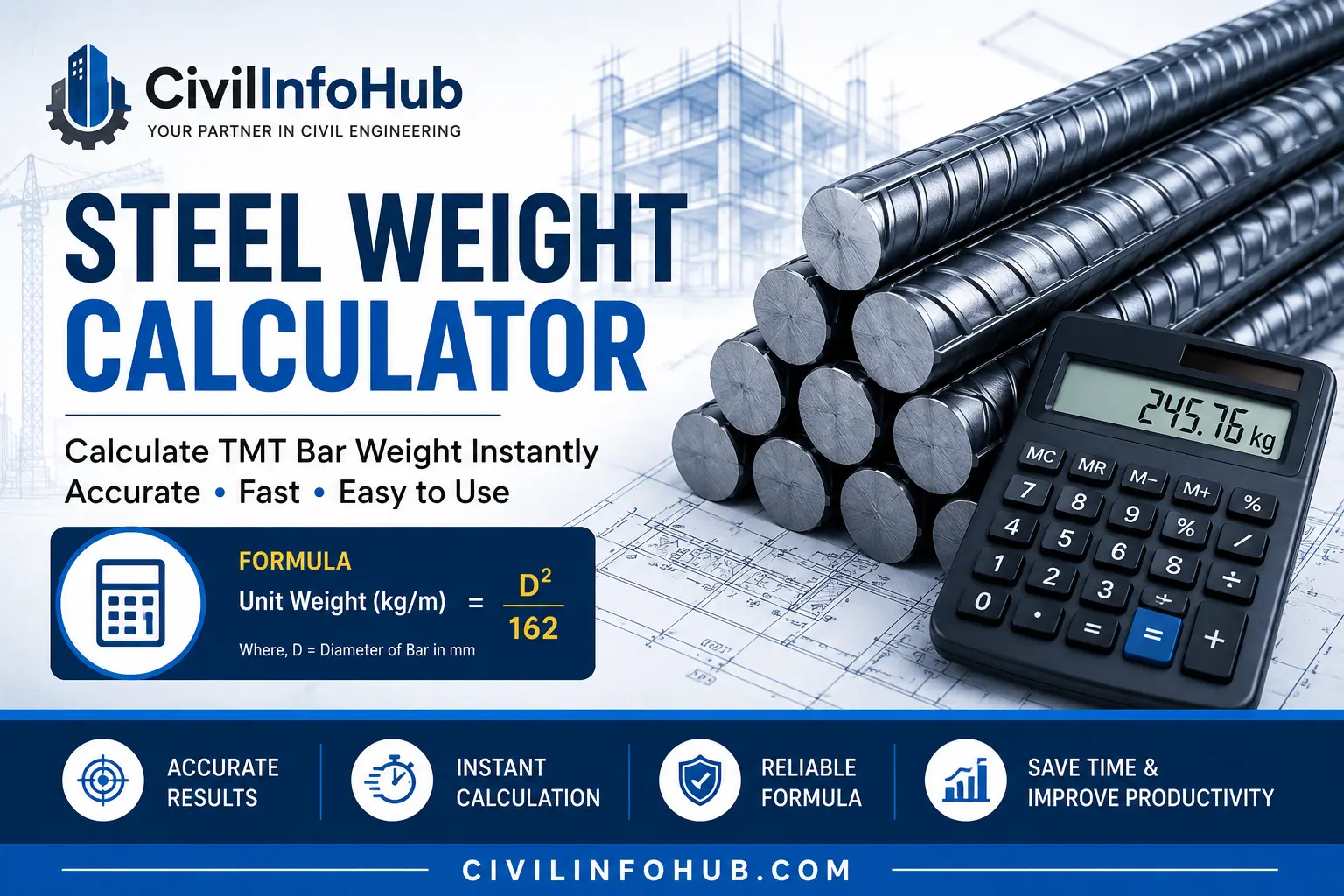
Steel (kg)=162D2×L
Shortcut Used on Site:
This formula saves time during estimation.
Q20. Rate Analysis
Answer:
Cost per unit work.
Includes:
Material + labor + profit
MOST ASKED QUESTIONS
- Water-cement ratio
- BBS
- Lap length
- Curing
- Slab types
PRACTICAL SITE TIPS (FROM EXPERIENCE)
- Never allow extra water in concrete
- Always check lap length before casting
- Use proper vibration
- Don’t skip curing
- Always verify drawings
COMMON INTERVIEW MISTAKES
- Speaking like a textbook
- No practical examples
- Not knowing basic values
- Lack of confidence
BONUS QUESTIONS
- What is bleeding?
- What is segregation?
- What is plinth level?
QUICK REVISION
- W/C ratio → strength
- Curing → durability
- Steel → tension
- BBS → cost control
INTERNAL LINK IDEAS
- Bar Bending Schedule Tutorial
- Concrete Mix Design
- Estimation Guide
- Quantity Surveying Basics
- Site Engineer Duties
FAQs
1. How to crack civil interviews?
Focus on practical knowledge.
2. What do interviewers check?
Your site understanding.
3. Are formulas important?
Yes, but concept matters more.
4. What is this article about?
This will brief you about Civil Engineering Interview Questions
CONCLUSION : Civil Engineering Interview Questions
If there’s one thing I’ve learned from interviews and site work, it’s this:
👉 Basics + Practical understanding = Selection
Don’t try to memorize everything. Instead, understand what actually happens on site.
In the next part, we’ll cover:
- QA/QC questions
- Advanced concrete problems
- Real interview scenarios
Stay connected with CivilInfoHub.com and keep improving step by step — that’s how real engineers grow.
Disclaimer
The information provided on CivilInfoHub.com is for educational and informational purposes only. All content, including civil engineering interview questions, explanations, and site-based insights, is created based on practical experience, industry knowledge, and general engineering practices.
While every effort has been made to ensure accuracy and reliability, the author makes no guarantees regarding the completeness, correctness, or suitability of the information for any specific project or situation. Civil engineering practices may vary depending on site conditions, local standards, and project requirements. Readers are advised to verify details with relevant codes, standards, or qualified professionals before applying any concepts in real-world projects.
The interview questions and answers shared on this website are intended to support learning and preparation. Actual interview questions may vary depending on the company, role, and experience level.
CivilInfoHub.com and its author shall not be held liable for any loss, damage, or consequences arising from the use of the information provided on this website.
All opinions expressed are those of the author based on personal experience and should not be considered as professional or legal advice.
By using this website, you agree to this disclaimer and accept full responsibility for how you use the information provided.
Read More
Freelancing for Civil Engineers – A Complete Guide
Bureau of Indian Standards — for IS codes, concrete standards, steel standards, mix design references.
Central Public Works Department — for construction specifications and quality practices.









2 thoughts on “Civil Engineering Interview Questions (2026) – Real Site Engineer Answers You Must Know – Part 1 : Check Out Now!”